
How snoring works: the mechanics of a vibrating airway
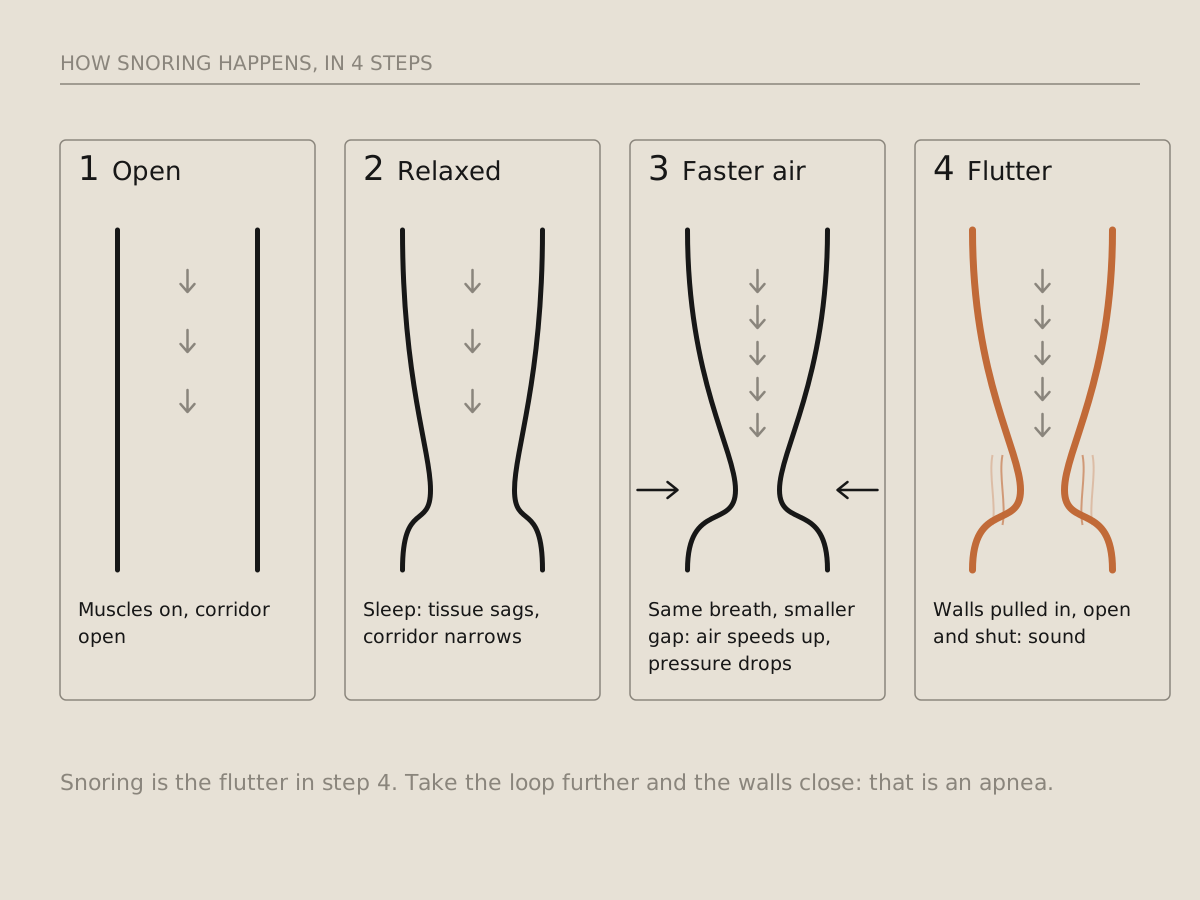
Snoring happens in 4 steps. Muscles in the throat relax during sleep and the airway narrows. Air moving through the narrower gap speeds up. Faster air means lower pressure against the walls, which pulls the soft tissue inward. The tissue flutters open and shut many times a second, and each flutter is a pulse of sound.
That's the whole mechanism. What varies is how hard it runs: some nights, some positions, some people.
Why does the airway narrow when you sleep?
While you're awake, the muscles lining the throat are switched on. They hold the soft palate up, keep the tongue forward, and brace the side walls. You never think about it.
Sleep turns the dial down. Muscle tone drops as you move from light sleep into deeper stages, and it drops furthest in REM, when most of the body's skeletal muscle is switched off. The throat has no cartilage rings holding it open, so when its muscles go slack it sags. Lying on your back, gravity adds to the sag by pulling the tongue base and soft palate backward. The anatomy of snoring covers which structures move.
The corridor is now narrower than it was 10 minutes earlier. Same lungs, same breath size, smaller pipe.
Why does air speed up?
Because the same amount of air has to get through in the same time. Push a breath through a narrower opening and the air moves faster, the way water speeds up when you half-cover a hose with your thumb.
Faster airflow is also more turbulent. Instead of sliding through in smooth layers, it tumbles and swirls, and turbulence on its own makes a hiss. That hiss is the quietest kind of "snoring," the heavy breathing that often precedes the real thing.
Why does faster air pull the walls inward?
This is the part people find surprising. Fast-moving air exerts less sideways pressure than slow-moving air (the Bernoulli effect). So as air speeds up through the narrow gap, the pressure inside the throat falls below the pressure of the tissue around it. The walls get sucked inward.
Now the gap is even narrower, air speeds up further, pressure drops further, and the walls come in further. It's a loop that runs toward closure.
Why does the tissue flutter instead of just closing?
Because closing stops the airflow, and stopping the airflow ends the suction. The instant the walls touch, the pressure difference disappears, the tissue springs back, air starts moving again, and the suction returns. Open, shut, open, shut.
That oscillation is the snore. Palatal tissue does it at low frequency, roughly 100 Hz for the soft palate in acoustic studies, so the snore sounds like a low rumble. Tongue-base tissue is stiffer and vibrates at higher, noisier frequencies. What causes the sound of snoring goes into how site becomes sound.
Engineers call a floppy tube that behaves this way a Starling resistor, and it's the standard physical model for the human pharynx. Vibration happens when the pressure inside the tube sits near the tube's collapsing pressure. Below that, the tube stays open and quiet. Above it, the tube shuts.
What decides whether you snore or stop breathing?
The same loop, run further. If the walls touch and stay touched, airflow stops. That's an obstructive apnea. If they nearly touch and airflow drops sharply without stopping, that's a hypopnea. Snoring, hypopnea, and apnea sit on one continuum of the same mechanics; the difference is how far the collapse goes and how long it lasts.
Most snorers don't have sleep apnea. The Wisconsin Sleep Cohort estimated sleep-disordered breathing (5 or more events an hour) in 24% of middle-aged men and 9% of women, well below the share who snore. But apnea almost always comes with snoring, because the run-up to a collapse is loud. That's why what snoring can mean is worth a read, and why the signs of sleep apnea are the ones to know.
Why is it worse on some nights?
Anything that narrows the corridor or softens its walls feeds the loop.
Alcohol within a few hours of bed relaxes throat muscle beyond what sleep alone does. Sedatives and some sleep aids do the same. A cold or allergies block the nose, push you to mouth breathing, and drop the jaw back. Sleeping on your back adds gravity. Being overtired deepens sleep and lowers muscle tone further. Weight gain adds tissue inside and around the throat. Age loosens the tissue itself.
Reverse any one of those and the loop runs less. That's the whole logic behind side sleeping, nasal strips, and skipping the nightcap.
How does the airway hold itself open at all?
Muscle tone is the answer, and it isn't constant even within a night. The genioglossus (the muscle that pulls the tongue forward) responds to the suction itself: when pressure drops in the throat, reflexes fire the muscle harder to hold the wall. That reflex is strong when you're awake, weaker in sleep, and blunted further by alcohol. How much reflex you have left is one reason two people with similar throats snore very differently. Why your airway matters at night covers the airway as a system.
What can you observe yourself?
You can't feel the loop while it's happening. What you can do is notice its footprint: how much of the night it ran, how loud, and whether it tracked position, alcohol, or congestion. How to track and monitor your snoring shows the practical options.
Nightsong is the app we built for that. It records from the nightstand with the raw audio staying on your phone, and shows snore burden and breathing regularity across your own nights, you vs you. It's a way to see the loop's footprint over time, not a diagnosis, and it doesn't replace a sleep study. It's the sensing layer of the Somnus platform and one piece of sleep as a wellness foundation.
This article is educational and not medical advice. Talk to a qualified clinician about your situation.
FAQ
What causes snoring in simple terms?
Relaxed throat tissue narrows the airway during sleep, air speeds up through the gap, the faster air pulls the tissue inward, and the tissue flutters. The flutter is the sound.
Why is snoring louder in deep sleep?
Muscle tone drops as sleep deepens and is lowest in REM, so the throat sags more, the gap narrows more, and the flutter is stronger.
Why does alcohol make snoring worse?
Alcohol relaxes throat muscle beyond what sleep alone does and blunts the reflex that normally pulls the tongue forward when pressure drops.
Is snoring the same as sleep apnea?
No. They share the same mechanics, but apnea is when the airway closes fully or nearly so and airflow stops or drops sharply. Most snorers don't have apnea; most people with apnea snore.
Can you snore with your mouth closed?
Yes. Nasal breathing can still drive palatal vibration, and some people snore through the nose. Mouth breathing usually makes it louder.
Sources
- Pevernagie D, Aarts RM, De Meyer M. The acoustics of snoring. Sleep Medicine Reviews 2010;14:131-144.
- A subject-specific acoustic model of the upper airway for snoring sounds generation. Scientific Reports 2016.
- Acoustic analysis of snoring and the site of airway obstruction in sleep related respiratory disorders. Acta Otolaryngol Suppl 1998.
- Young T, et al. The occurrence of sleep-disordered breathing among middle-aged adults. N Engl J Med 1993;328:1230-1235.