
The anatomy of snoring: which parts of the throat make the noise

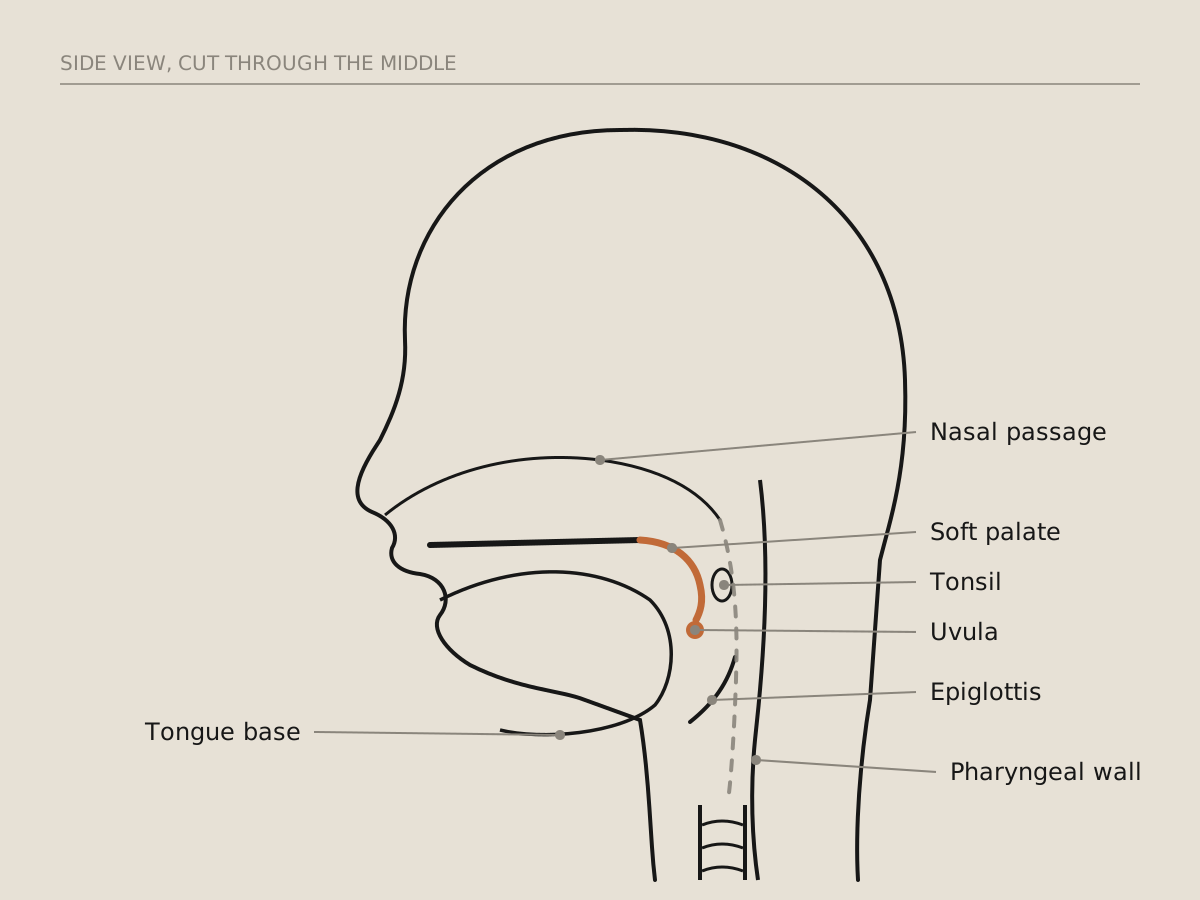
Snoring is the sound of soft tissue in the upper airway vibrating as air squeezes past it. Five structures do most of the vibrating: the soft palate and uvula at the back of the roof of the mouth, the tonsils on either side, the base of the tongue, and the side walls of the throat. The nose doesn't usually vibrate, but a blocked nose forces mouth breathing and raises the airflow speed that sets everything else shaking.
Where the vibration happens changes what the snore sounds like, which is why one person rattles and another rumbles.
What is the upper airway, exactly?
The upper airway is the soft tube running from the nostrils and lips down to the top of the windpipe. Unlike the windpipe, which is held open by rings of cartilage, most of this tube is muscle and mucous membrane with nothing rigid holding it open. It stays open while you're awake because the muscles lining it are active.
Three regions matter for snoring. The nasopharynx sits behind the nose. The oropharynx sits behind the mouth, where the soft palate, uvula, tonsils, and back of the tongue crowd together. The hypopharynx sits lower, behind the tongue base and epiglottis, just above the voice box. Air has to pass all three on every breath.
Which structure vibrates most?
The soft palate. It's a flap of muscle and tissue hanging off the back of the hard palate, with the uvula dangling from its center. When you sleep, it relaxes and drifts backward. Air passing between the palate and the tongue makes it flutter, a bit like a flag in wind, and each flutter is a pulse of sound.
Palatal snoring is the classic low, rhythmic snore. Acoustic studies put its fundamental frequency low, on the order of 100 Hz, with palatal vibration producing a strong pulsing quality below about 100 Hz in the loudness envelope.
Why does the tongue matter?
The tongue is a large muscle anchored to the jaw. Lying on your back, gravity pulls its base toward the back wall of the throat. Muscle tone drops during sleep, so it drifts further. The gap behind the tongue narrows, air speeds up, and either the tongue base itself or the tissue around it starts to vibrate.
Tongue-base snoring sounds different: higher, harsher, more noise-like. Studies that matched the site of narrowing to the sound found tongue-base snoring carrying its main energy above 500 Hz or so, sometimes above 650 Hz, while palatal snoring stayed below about 450 Hz. If you've heard someone switch from a rumble to a rasp when they roll onto their back, you've heard the site change.
What do the tonsils do?
Tonsils are lumps of lymphoid tissue on each side of the oropharynx. Large tonsils take up space in an already crowded corridor. In children they're the most common anatomical cause of snoring. In adults they matter less on average but can still be the main obstruction in some people.
Does the nose cause snoring?
Indirectly, and often. A deviated septum, swollen turbinates, allergies, or a cold all raise nasal resistance. In Wisconsin, ragweed season and furnace season both do it. When the nose is hard to breathe through, you open your mouth, and mouth breathing does two things: it drops the jaw and tongue backward, and it bypasses the nose's filtering and humidifying. The soft palate ends up vibrating harder because more air is moving faster through a narrower space.
Nasal strips and decongestants help some people because they move breathing back to the nose. They don't fix a palate or tongue problem.
Why does anatomy differ so much between people?
A short lower jaw (retrognathia) sets the tongue further back. A thick neck adds tissue around the outside of the throat. A long soft palate or a large uvula hangs further into the airflow. Extra weight deposits fat in the tongue and pharyngeal walls. Age loosens muscle tone. Alcohol relaxes it further. Each of these narrows the corridor or softens its walls, and snoring is what a narrow, soft corridor sounds like.
The scale of it is large. In a survey of 5,713 US adults, 24% of men and 13.8% of women reported habitual snoring, and other population studies land in the same range.
How do you find out which part is doing it?
A clinician can look. Sleep endoscopy (a camera passed through the nose while you're sedated) shows which structure collapses. Acoustic analysis can estimate the site from the sound alone, which is why researchers care about the frequency bands above.
At home you can notice patterns without naming a structure: does it happen only on your back, only after drinks, only during allergy season? Those are anatomy clues. How to track and monitor your snoring walks through the practical version. For the physics of the vibration itself, read how snoring works, and for why the sound varies, what causes the sound of snoring.
Nightsong is the app we built for exactly this kind of noticing. It listens from the nightstand, keeps the raw audio on your phone, and shows you how your own snore burden moves night to night, you vs you. It doesn't identify which structure is vibrating and it isn't a diagnosis. It gives you a record to bring to someone who can look. That sensing layer is the first step of the Somnus platform.
For the bigger picture, see what snoring can mean and sleep as a wellness foundation.
This article is educational and not medical advice. Talk to a qualified clinician about your situation.
FAQ
What part of the body causes snoring?
Mostly the soft palate and uvula at the back of the mouth, followed by the base of the tongue, the tonsils, and the side walls of the throat. A blocked nose makes all of them worse by forcing mouth breathing.
Why do I only snore on my back?
Lying on your back lets gravity pull the tongue base and soft palate backward, narrowing the airway. Side sleeping moves them forward. Position-dependent snoring is common and often points to the tongue base.
Can big tonsils cause snoring in adults?
Yes, though it's more common in children. In adults, enlarged tonsils can still be the main obstruction, and an ENT can assess them.
Does a deviated septum cause snoring?
It raises nasal resistance, which pushes you toward mouth breathing and louder palatal snoring. Fixing the nose helps some people and does nothing for others, depending on where the vibration actually is.
Sources
- Pevernagie D, Aarts RM, De Meyer M. The acoustics of snoring. Sleep Medicine Reviews 2010;14:131-144.
- Acoustic analysis of snoring and the site of airway obstruction in sleep related respiratory disorders. Acta Otolaryngol Suppl 1998;537:47-51.
- Palatal snoring identified by acoustic crest factor analysis. Physiol Meas 1999.
- Subject-specific acoustic model of the upper airway for snoring sounds generation. Scientific Reports 2016.
- The prevalence of snoring in adult population (survey of 5,713 US adults).