
What causes the sound of snoring?
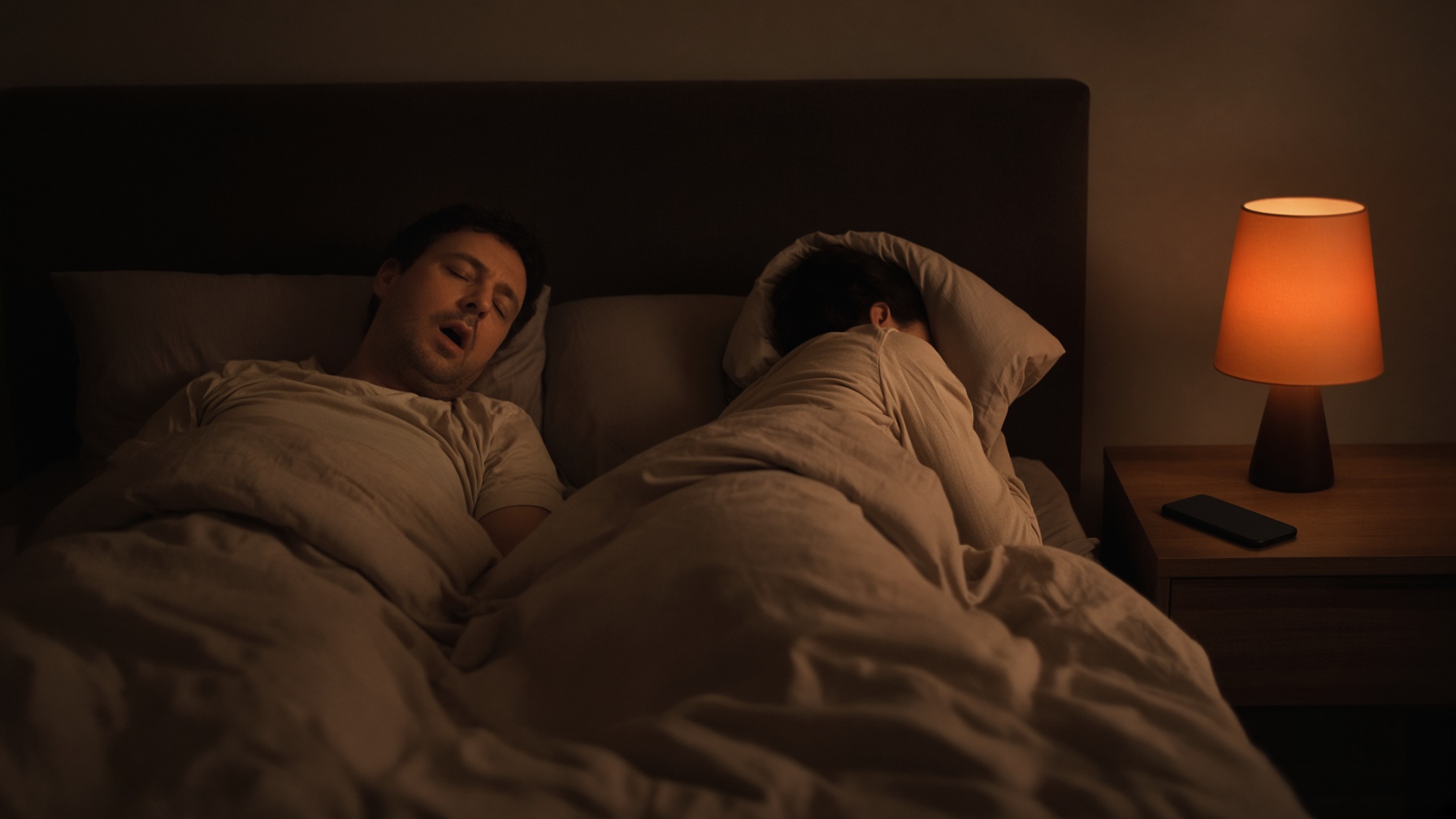
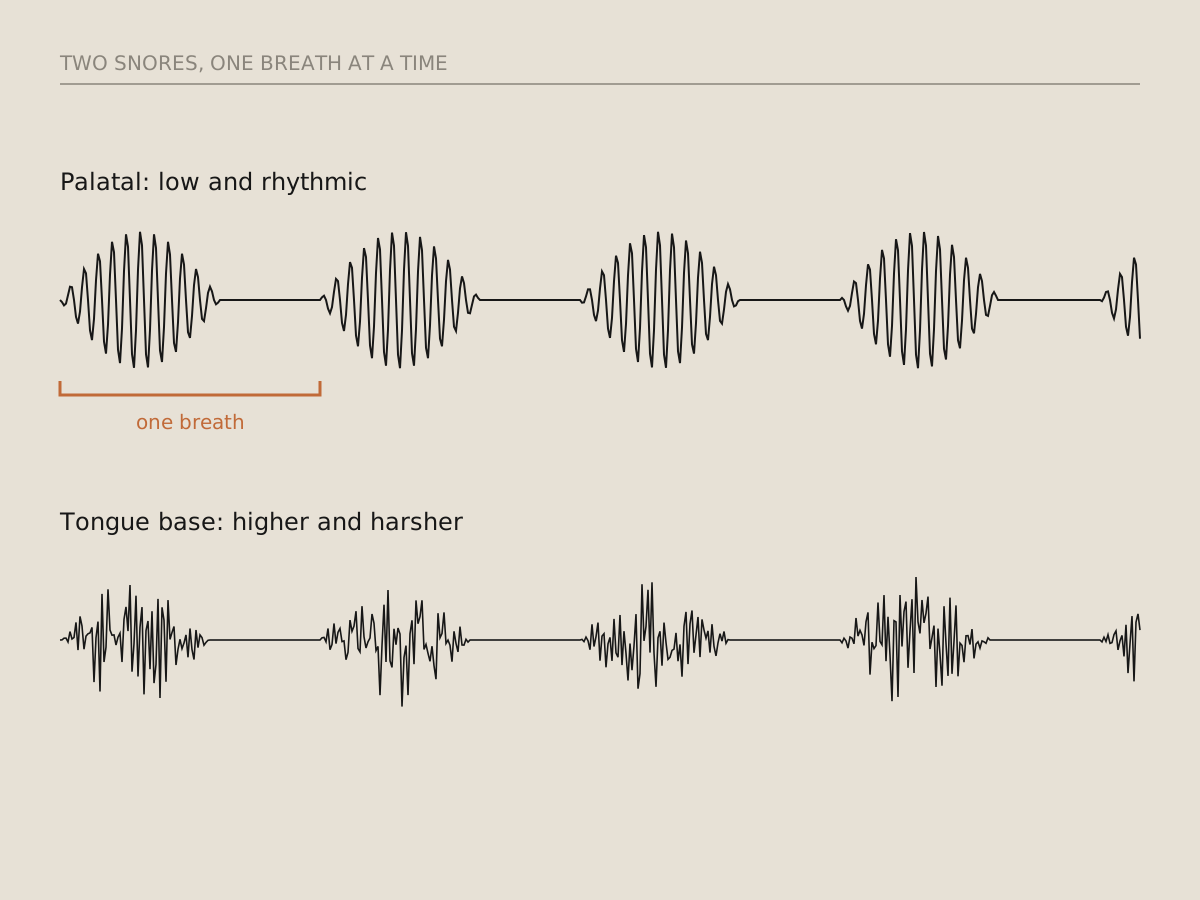
The sound of snoring is soft tissue in the throat flapping open and shut as air rushes past it. Which tissue is flapping sets the pitch: the soft palate gives a low rumble, the tongue base gives a higher rasp. How much air is moving sets the loudness. Your breathing sets the rhythm, one burst per breath in. Mouth open or closed changes the tone, because the mouth is a resonating chamber.
So a snore has 4 ingredients: a vibrating part, an airflow, a breathing rhythm, and a resonator. Change any one and the sound changes.
Where does the vibration come from?
Sleep relaxes the muscles that hold the throat open. The airway narrows, air speeds up through the gap, the faster air drops the pressure against the walls, and the walls get pulled inward until they flutter. How snoring works covers that loop in detail. The anatomy of snoring covers the parts.
What matters for the sound is that flutter is periodic. Tissue opens, air escapes in a puff, tissue shuts, pressure rebuilds, tissue opens again. Each puff is a pressure pulse in the air, and a train of pulses is a tone.
What sets the pitch?
The mass and stiffness of whatever is vibrating. Heavy, floppy tissue flutters slowly; lighter, tighter tissue flutters fast.
The soft palate and uvula are the heaviest, floppiest structures in the airway, so palatal snoring has the lowest pitch. Acoustic studies put its fundamental frequency around 100 Hz, roughly the pitch of a low male speaking voice, with a strong pulsing quality under 100 Hz that gives it the "sawing" character.
The tongue base and tonsils are stiffer and their vibration is less orderly, so the sound is higher and more noise-like, with energy spread above 500 Hz and sometimes above 650 Hz. Snoring from around the epiglottis and larynx sits in between, around 250 Hz in one series.
This is why a bed partner can often hear the site change. Roll from side to back and a rumble turns into a rasp: the tongue base has joined in.
What sets the loudness?
Airflow, mostly. The harder you're breathing, the more air pushes through per second and the bigger each pressure pulse. That's why snoring gets louder in deep sleep and REM (muscle tone is lowest, so the gap is narrowest and the effort to pull air through is highest), after alcohol, and with a blocked nose.
The gap size matters too, in a non-obvious way. A moderately narrow gap makes the loudest snore. A very narrow gap moves too little air to make much noise, and a fully closed gap makes no sound at all, which is one reason silence in the middle of a run of snoring is worth paying attention to.
Loud is loud. In a sleep-lab series of 1,913 patients measured with a calibrated sound meter, mean maximal snoring intensity was 50 dB for women and 51.7 dB for men, and the researchers classed anything over 60 dB as very severe. People also underestimate their own. In that same series, 88% of the women were recorded snoring but only 72% said they did.
What sets the rhythm?
Your breathing. Snoring almost always rides the in-breath, because that's when air is being sucked through the gap and the suction pulls the tissue in. The out-breath pushes the tissue away and is usually quieter, though some people snore on both.
So the pattern is: a burst lasting a second or so, silence for a few seconds, another burst. Regular breathing gives regular snoring. When breathing becomes irregular, the snoring does too: bursts get longer or louder, then stop, then restart with a gasp. That change in rhythm is often the first thing a partner notices, before anyone has counted anything.
Why does mouth breathing change the tone?
The mouth and the nose are two different resonating spaces. Breathe through the nose and the vibration is muffled by the palate and nasal passages, producing a more closed, nasal tone. Open the mouth and you add a large, open cavity, which makes the snore louder and rounder, and drops the jaw so the tongue base joins the vibration.
Nasal snoring sounds like a hum or a whistle. Mouth snoring sounds like a saw. Same throat, different resonator.
Why does the sound vary from night to night?
Because the 4 ingredients vary. Congestion changes the resonator. Alcohol and exhaustion change muscle tone and therefore which tissue vibrates. Position changes the gap. A late, heavy meal changes breathing effort. Two recordings of the same person a week apart can sound like 2 different people.
That variability is why a single night tells you little and a run of nights tells you a lot. How to track and monitor your snoring covers how to build that record.
Nightsong is the app we built for it. It listens from the nightstand, keeps the raw audio on your phone, and turns the sound into a snore burden number you can compare across your own nights, you vs you. It doesn't tell you which tissue is vibrating and it isn't a diagnosis. It shows you the shape of your nights so a conversation with a clinician can start from a pattern. That sensing layer is the first step in the Somnus platform, and part of sleep as a wellness foundation. For the health side of the question, read what snoring can mean.
This article is educational and not medical advice. Talk to a qualified clinician about your situation.
FAQ
Why is my snoring so loud?
Loudness tracks airflow and gap size. Deep sleep, alcohol, a blocked nose, and back sleeping all narrow the airway and raise breathing effort, which makes each pulse of sound bigger.
Why does snoring sound different in different people?
Because different tissues vibrate. Soft-palate snoring is low and rhythmic; tongue-base snoring is higher and harsher. Mouth breathing adds a large resonating space and makes everything louder.
Why do people snore when they breathe in and not out?
The in-breath sucks air through the narrowed gap and pulls the tissue inward, which starts the flutter. The out-breath pushes tissue away, so it's usually quieter.
Can the sound of snoring tell you where the blockage is?
Partly. Researchers use frequency analysis to estimate the site, and a low rumble versus a high rasp is a rough clue. Confirming it takes a clinician looking at the airway.
Why does my snoring change from night to night?
Congestion, alcohol, tiredness, position, and meal timing all shift which tissue vibrates and how much air moves. That's why a run of nights is more useful than one.
Sources
- Pevernagie D, Aarts RM, De Meyer M. The acoustics of snoring. Sleep Medicine Reviews 2010;14:131-144.
- Acoustic analysis of snoring and the site of airway obstruction in sleep related respiratory disorders. Acta Otolaryngol Suppl 1998.
- Palatal snoring identified by acoustic crest factor analysis. Physiol Meas 1999.
- Westreich R, et al. The presence of snoring as well as its intensity is underreported by women. J Clin Sleep Med 2019. (AASM summary)
- Snoring: is a reliable assessment possible? Eur Arch Otorhinolaryngol 2020.