
Understanding your upper airway: why it matters at night

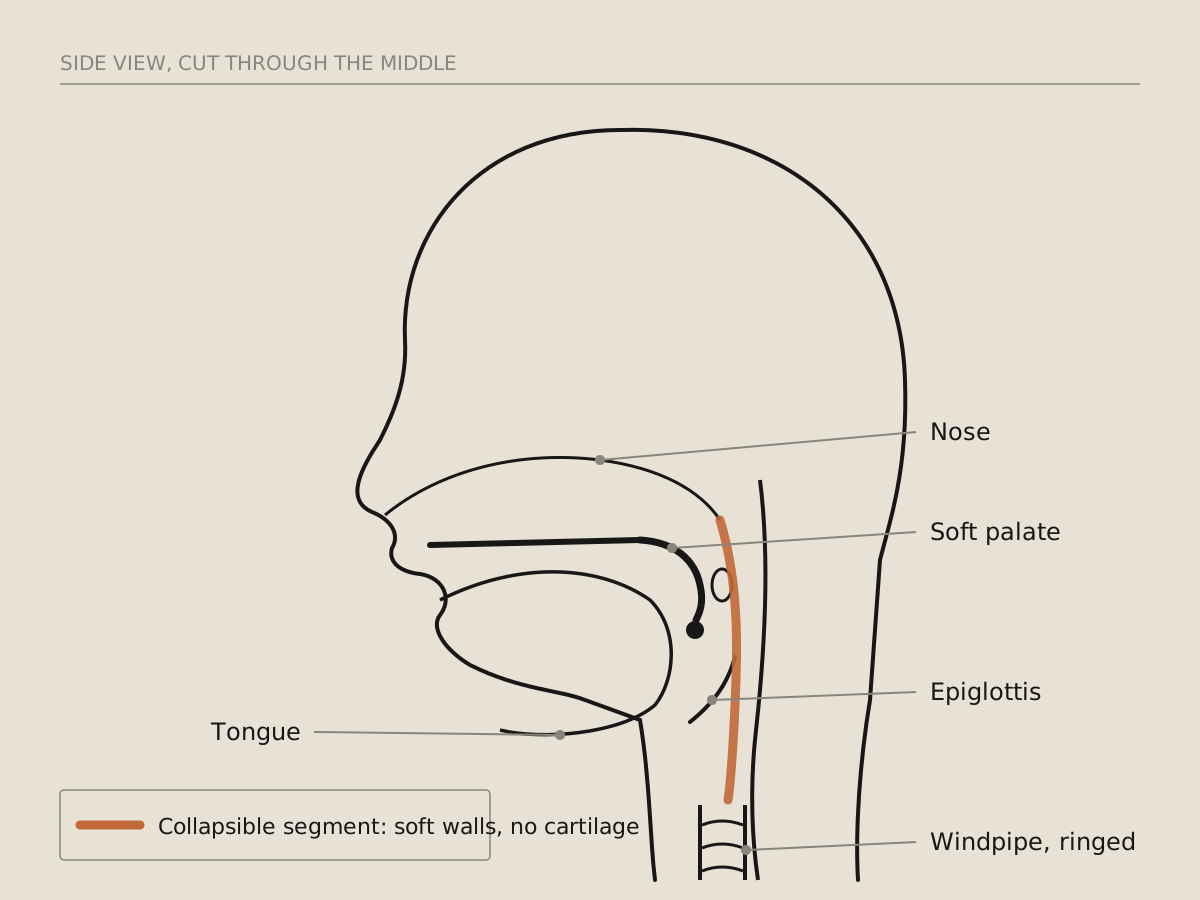
The upper airway is the passage air takes from your nostrils and lips down to the top of the windpipe. It's about 15 cm long, walled mostly by muscle and soft tissue, and it's the only stretch of the breathing path with nothing rigid holding it open. That's why it matters at night: when the muscles relax in sleep, this is the part that narrows, vibrates, or closes.
Everything from quiet nasal breathing to snoring to sleep apnea plays out in those 15 cm.
What is the upper airway made of?
Start at the top. The nose has two passages divided by the septum, lined with turbinates (shelves of tissue that warm and moisten air) and connected to the sinuses. Behind the nose is the nasopharynx.
Below that is the oropharynx, behind the mouth. This is the crowded part: the soft palate and uvula hang from above, the tonsils sit on the sides, and the back of the tongue fills the front. Below that is the hypopharynx, behind the tongue base, where the epiglottis sits like a lid above the voice box.
Then the larynx, and below it the trachea, which is held open by rings of cartilage. From the trachea down, the airway can't collapse. From the larynx up, it can. The anatomy of snoring goes through the structures one at a time.
Why is it the only part that collapses?
Because it has to do more than one job. The same passage carries air to the lungs, food to the stomach, and sound out of the larynx. To swallow, the soft palate has to seal off the nose and the tongue has to push backward. To speak, the shape has to change constantly. Cartilage rings would make all of that impossible.
So the upper airway is built soft and held open by muscle. Roughly 20 muscles line it, and while you're awake they're active without you thinking about it: the genioglossus pulls the tongue forward, the palatal muscles lift the palate, the pharyngeal muscles brace the walls.
What happens to it when you fall asleep?
Muscle tone drops. It falls through light sleep, further in deep sleep, and furthest in REM, when most skeletal muscle is switched off. The walls go slack, the tongue drifts back, and the passage narrows. Lying on your back, gravity helps it along.
Narrower means air moves faster to get through, and faster air lowers the pressure against the walls, pulling them in further. If the walls start to flutter, that's snoring. If they nearly touch and airflow drops, that's a hypopnea. If they close, that's an obstructive apnea. How snoring works covers that chain in detail. The point here is that it's one chain, and the upper airway is where it runs.
Does it matter whether I breathe through my nose or mouth?
Yes, for 3 reasons.
The nose conditions air. Turbinates warm and humidify it and filter dust and particles before it reaches the throat. Mouth breathing skips that, which is why mouth breathers wake with a dry throat.
The sinuses produce nitric oxide. Work by Jon Lundberg and colleagues in the 1990s showed the paranasal sinuses continuously release nitric oxide into nasal air, and that breathing through the nose carries it to the lungs, where it widens blood vessels and appears to improve oxygen uptake. Mouth breathing bypasses the supply.
And the mouth changes the shape of the airway. Opening it drops the jaw and lets the tongue fall back, narrowing the oropharynx. A blocked nose is one of the most common reasons a quiet sleeper becomes a loud one. Mouth breathing vs nasal breathing compares the two routes.
What makes an upper airway narrow to begin with?
Some of it is fixed. A short or set-back lower jaw puts the tongue closer to the back wall. A long soft palate or large tonsils take up space. A narrow hard palate leaves less room for the tongue.
Some of it moves. Weight gain deposits fat in the tongue and around the throat walls. Age loosens tissue. Alcohol and sedatives relax muscle beyond what sleep does. Allergies and colds block the nose. Sleeping on your back adds gravity.
The mix is different in every person, which is why the same fix (a nasal strip, side sleeping, weight loss) works for one snorer and does nothing for another.
How common is upper airway trouble?
Very. A 2019 analysis in The Lancet Respiratory Medicine estimated 936 million adults aged 30 to 69 worldwide have at least mild obstructive sleep apnea, and 425 million have moderate to severe. Population surveys put habitual snoring at roughly a quarter of men and one in eight women. Most of it is undiagnosed and unmeasured.
We use "upper airway dysfunction" as the umbrella for this: snoring, sleep apnea, and the related ways the upper airway narrows or collapses at night. It's the problem Somnus is built around. At the wellness end, Nightsong listens from the nightstand and shows you your own snore burden and breathing regularity night to night, you vs you, with the raw audio staying on your phone. That's awareness, not a diagnosis. At the clinical end, diagnosis and treatment belong with sleep physicians, ENTs, and dentists. The Somnus platform is how we connect the two.
What can I do for my upper airway?
Keep the nose open: treat allergies, manage congestion, and try a nasal strip or dilator if the nose is the bottleneck. Sleep on your side if back sleeping is loud. Leave a few hours between the last drink and bed. Keep weight in a range that doesn't crowd the throat. Some people benefit from exercises that tone the tongue and palate (myofunctional therapy), which a speech or sleep specialist can teach.
Then notice. Two weeks of how the nights sound and how the mornings feel tells you more than any single night. Breathing regularity at night covers the steadiness side, what snoring can mean covers the sound, and sleep, breathing, and longevity covers why it adds up over years. All of it sits inside sleep as a wellness foundation.
If the nights are loud most of the time, or a partner hears pauses, bring the pattern to a qualified clinician.
This article is educational and not medical advice. Talk to a qualified clinician about your situation.
FAQ
What is the upper airway?
The breathing passage from the nostrils and lips down to the top of the windpipe: nose, nasopharynx, the space behind the mouth, and the space behind the tongue base. It's walled by muscle and soft tissue rather than cartilage, so it can narrow or collapse during sleep.
Why does the upper airway collapse during sleep?
Muscle tone drops in sleep, especially in REM, so the soft walls sag and the tongue drifts back. Faster airflow through the narrower gap lowers pressure against the walls and pulls them further in.
What is upper airway dysfunction?
An umbrella term for the ways the upper airway narrows or closes at night: snoring, flow limitation, hypopneas, and obstructive sleep apnea. Diagnosis of any of them requires a clinician and a sleep test.
Is nasal breathing better than mouth breathing at night?
Usually. The nose warms, humidifies, and filters air, delivers nitric oxide from the sinuses, and keeps the jaw and tongue forward. Mouth breathing skips all three and often makes snoring louder.
How can I keep my upper airway open at night?
Keep the nose clear, sleep on your side, leave a gap between alcohol and bedtime, and manage weight. If loud nights or breathing pauses persist, see a clinician.
Sources
- Lundberg JO. Nitric oxide and the paranasal sinuses. The Anatomical Record 2008;291:1479-1484.
- Lundberg JO, et al. Inhalation of nasally derived nitric oxide modulates pulmonary function in humans. Acta Physiol Scand 1996.
- Benjafield AV, et al. Estimation of the global prevalence and burden of obstructive sleep apnoea: a literature-based analysis. Lancet Respir Med 2019;7:687-698.
- Young T, et al. The occurrence of sleep-disordered breathing among middle-aged adults. N Engl J Med 1993.
- Pevernagie D, Aarts RM, De Meyer M. The acoustics of snoring. Sleep Medicine Reviews 2010.