Somnus Technologies

We are building
the infrastructure layer for upper airway
dysfunction.

Sensing, scoring, routing, therapy, outcomes:
one connected system that does not exist in the market today.

We power every decision with AI.

Book a call

Somnus is building the infrastructure layer for upper airway dysfunction.

The missing piece is infrastructure: sensing, scoring, routing, therapy, and outcomes connected as one system that does not exist in the market today.

84M1

American adults have obstructive sleep apnea.
About 80% don't know it.2

54 million by the most conservative widely-cited estimate.4

  • 84 M US adults with OSA (32.4% prevalence), based on 2024 data1
  • ~80% undiagnosed: 68.5 M of 85.6 M have never been diagnosed2
  • CPAP non-adherence ~34%, unchanged over 20 years; 63% discontinue within one year3

Snoring is the most common early sign of OSA.

What causes the upper airway dysfunction diagnosis gap?

The gap is infrastructure: no connected system carries a patient from sensing to scoring to routing to therapy to outcomes.

The market keeps improving individual tools: better CPAP machines, smarter oral appliances, refined surgical techniques. Each one is open-loop. None of them connects to the next, so patients fall through the handoffs between them.

Somnus closes that loop: consistent sensing, a scoring standard, routing, therapy, and outcome capture, connected end to end instead of stopping at each handoff.

How does the Somnus closed-loop system work?

Six stages. One connected system. Built to keep improving over time.

We are building the loop.

AI-powered insight across every step of the loop.

Nightsong™ + BSA™ Acoustic · any phone SENSOR future Agent All nodes SENSOR Bedside Node™ SENSOR Therapy Outcomes Post-procedure data FEEDBACK Provider Directory™ HYPNARA™ Implant THERAPY MORPHEX™AI THERAPY Other Competing therapies CPAP · HGNS · OTHER

SOMNUS INDEX · THE HUB

  1. Sense

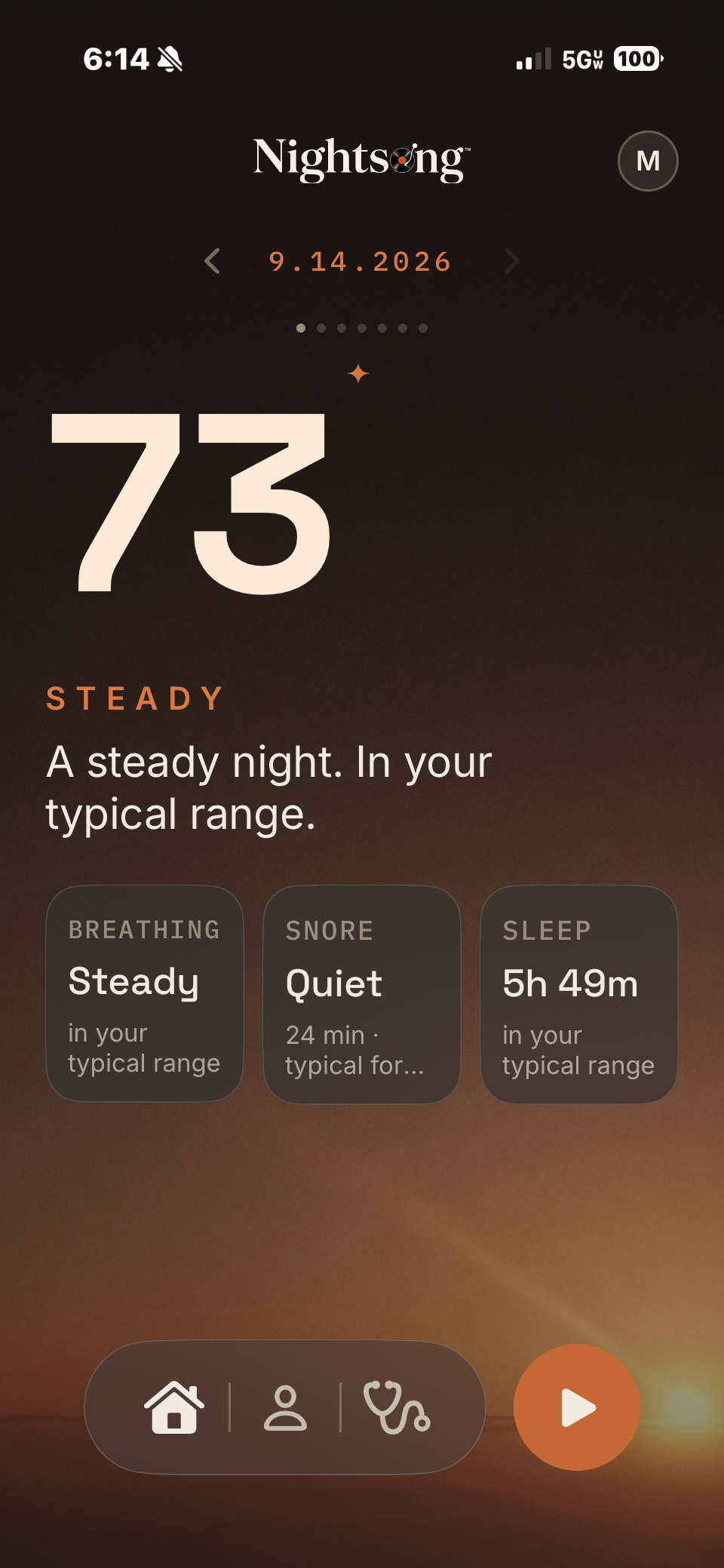
    Nightsong and MORPHEXAI turn smartphones and oral devices into continuous airway sensors: zero hardware required to enter the funnel.

  2. Score

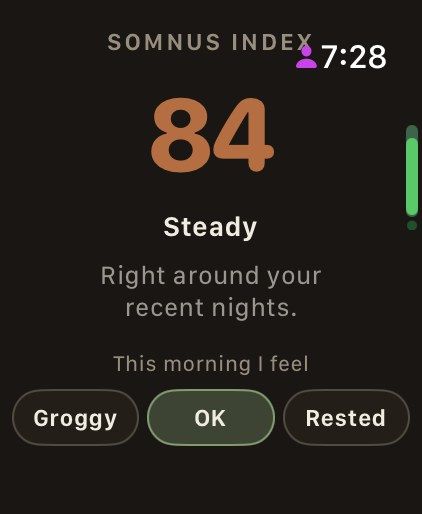
    The Somnus Index is your breathing credit score, a wellness metric driven by Somnus analytics and on-device AI.

  3. Route

    Intelligent routing is a roadmap capability on the device-software track.

  4. Therapy

    HYPNARA and MORPHEX AI give providers and patients effective, minimally invasive options: from a 20-minute in-office implant to a smart oral device with on-device analytics.

  5. Outcomes

    The platform captures adherence, wellness score changes, and patient-reported experience, tracking how patients actually do over time, which the open-loop market doesn't.

  6. Re-score

    Outcomes feed back into the platform, so it keeps getting better over time.

Built for the long term.

What does Somnus build?

Four components of the closed-loop system, at varying stages of development.

SHIPPING FIRST · ENROLLING NOW

Nightsong + the Somnus Index

Any phone becomes the sensor. No wearable, no hardware, nothing to buy.

Real data, measured. Nightsong listens to how you actually breathe at night and turns it into the Somnus Index — one plain-language wellness number that moves with you, night over night. Think of it as a credit score for your breathing.

Deterministic edge compute. Every night is scored on your device, in real time. The same inputs always produce the same number — nothing estimated, nothing simulated, no cloud round-trip required.

Your data is your data. The analysis happens on the phone in your hand. Your recordings stay on your device, and you decide if anything is ever shared.

Built to the FDA's General Wellness policy — a low-risk tool to understand your sleep. Not a medical device, and not a diagnosis.

TestFlight beta opens August 2026 · public launch to follow this fall
Smart Oral Device

MORPHEX AI

A smart oral device with on-device airway analytics, supported by an AI/ML clinical decision layer. Staged across three regulatory phases so each step funds the next. MORPHEX AI supports clinical decision-making; it does not diagnose independently.

Near-term 510(k) workstream. Not yet available.

Structural Device

HYPNARA

A passive structural palatal implant for snoring and mild-to-moderate sleep apnea. Physical reinforcement of the soft palate — no electronics, no AI.

FDA 510(k) pathway; Pre-Submission complete May 7, 2026, clinical study next. Not yet FDA cleared or for sale.

Network

Somnus Provider Directory

A patient-browsable directory of sleep-health providers sourced from public registry data. Neutral and informational: no credentialing claim, wellness context. The routing intelligence layer is a roadmap capability on the device-software track.

Intellectual Property

Multiple patent-pending applications across the platform.

We pay attention to what happens after therapy, not just before it.

How does Somnus navigate regulatory risk?

Software side: de-risked

Counsel review concludes the Nightsong app, the BSA acoustic engine, and the Somnus Index fit within the FDA General Wellness Policy.

"FDA-classification de-risked on the software side" is the lead de-risking headline.

Hardware path: deliberate

  • Pre-Submission complete May 7, 2026
  • FDA confirmed the 510(k) pathway and our predicate device
  • Clinical study is next, as planned

This is who we are.

We’re building the closed-loop data network for upper airway care, connecting every signal so no patient is lost to a handoff, and making the whole system smarter and more affordable as it grows. We intend to set the standard. Not the loudest, not the first to ship a gadget: the best at the thing that actually matters, and proving it with clinical efficacy rather than claiming it.

We respect expertise. We tell the truth about what’s built and what isn’t. We earn trust the slow way, because it’s the only way that holds.

You don’t have to agree with how we work. But if you do (if you want the best solution, done the right way), there’s a place for you here.

Ready to learn more?

Somnus Technologies is built for the long term: lean, close to patients and providers, owning the loop.

Book a call

1 Sönmez et al., Respiratory Medicine 2025;248:108348. DOI: 10.1016/j.rmed.2025.108348. 84 million US adults with OSA; 32.4% prevalence (2024 data).

2 Sönmez et al., Sleep 2025;48(Suppl_1):A278. 68.5 M of 85.6 M US OSA adults undiagnosed (80%); 63% PAP discontinuation at one year.

3 CPAP non-adherence ~34%, unchanged over 20 years. [Flattened-curve systematic review; citation to be verified before publish.] Sönmez et al., Sleep 2025;48(Suppl_1):A278 (63% PAP discontinuation at one year).

4 Benjafield et al., Lancet Respiratory Medicine 2019. Conservative estimate: 54 million US adults with OSA.

Somnus Index is a wellness metric under FDA General Wellness Policy. Not a medical device.