
What is snore burden?

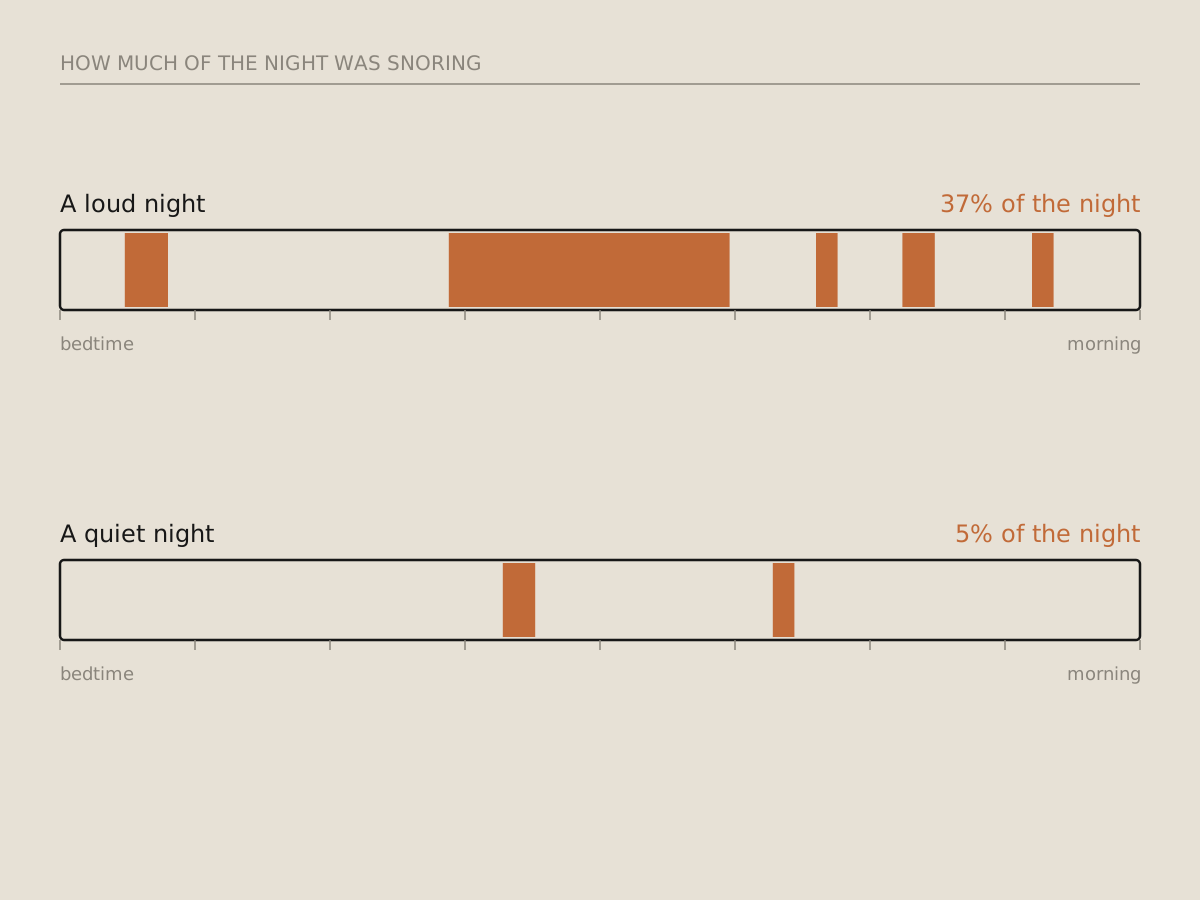
Snore burden is how much of your night is taken up by snoring. At its simplest it's the share of sleep time spent snoring: 2 hours of snoring in an 8-hour night is a 25% burden. Fuller versions weight that time by how loud the snoring was and how sustained the runs were, so a night of constant moderate snoring and a night of a few loud bursts get different numbers.
It's the answer to "how much," where most snoring questions only ever get "yes" or "no."
Why isn't "do you snore" enough?
Because almost everyone snores sometimes, and the yes/no answer hides everything that matters. A person who snores for 10 minutes after a glass of wine and a person who snores for 5 hours every night both say yes.
The yes/no answer is also unreliable. In a sleep-lab series of 1,913 patients, 88% of the women were recorded snoring and only 72% said they did. Partners are better at noticing than at measuring. Burden replaces an opinion with a quantity.
How is snore burden measured?
From sound, over a whole night. A microphone (on a nightstand, in a phone) or a vibration sensor (under the mattress) records the night, software finds the snore events, and the events are added up.
Three things go into the number. Time: how many minutes, or what percentage of sleep, had snoring. Intensity: how loud, usually in decibels at the sensor. Continuity: whether the snoring came in long uninterrupted runs or scattered bursts. The largest objective study to date, 12,287 people monitored nightly for about 6 months with under-mattress sensors, used the percentage of sleep time spent snoring as its measure. It found 29% of participants snored more than 10% of the night on average, 14% more than 20%, and 7% more than 30%.
Nightsong, the app we built, reports snore burden from a phone on the nightstand, with the raw audio staying on the phone. It shows the number against your own previous nights, you vs you, and it pairs with breathing regularity to feed the Somnus Index, a general-wellness read of how your nights are trending. If a night wasn't heard properly, there's no burden number and no Index for it. Which is the point: a made-up number is worse than none. We pulled the score off unheard nights this summer after it kept printing a reassuring number over silence. For scale, a quiet night on one of our own phones read 7.8%.
How is snore burden different from AHI?
The apnea-hypopnea index counts breathing events per hour: how many times airflow stopped or dropped sharply. It's the clinical measure of sleep apnea and it comes from a sleep study.
Snore burden counts snoring, which is sound. The two are related, because the airway that collapses is the airway that vibrates, but they aren't the same thing. Plenty of heavy snorers have a low AHI. Some people with a high AHI snore only a little. Snore burden is a wellness measure you can gather at home for months; AHI is a diagnostic measure a clinician orders and reads.
Why does snore burden matter?
Because time spent snoring tracks with things people care about, independent of apnea.
In the 12,287-person study, people at the 75th percentile of snoring time (about 12% of the night) had roughly 1.9 times the odds of uncontrolled high blood pressure compared with people at the 5th percentile, after adjusting for age, body mass, sex, and estimated apnea severity. Smaller studies have linked objective snoring time in non-apneic women to thicker carotid artery walls. These are associations, not proof that snoring causes either, and no consumer measure diagnoses anything. But they're the reason the quantity is worth knowing.
The nearer reason is practical. Burden is what a partner actually experiences. A 30% burden night is a night someone else didn't sleep.
Why does snore burden change so much night to night?
Because snoring does. Alcohol, congestion, exhaustion, sleeping position, and a late meal all move it, sometimes from near zero to a third of the night in the same person in the same week. What causes the sound of snoring covers the mechanics.
That's why one night's burden means little and a run of nights means a lot. Two weeks shows you your typical range. A month shows whether side sleeping or skipping the nightcap moved it. Comparing yourself with yourself is the only comparison that's fair, because your anatomy is the constant.
What's a "good" snore burden?
Lower than your own baseline, on more nights. There's no published cut-off that separates fine from not fine, and any product that gives you one is guessing. The useful read is the trend: is the number drifting up over months, did a change bring it down, and does a high-burden night line up with a rough morning.
If burden is high most nights, or comes with pauses a partner notices, gasping, or waking unrefreshed, that's a pattern to bring to a clinician. What snoring can mean covers when to pay attention. How to track and monitor your snoring covers how to build the record, and Nightsong is one way to do it. It's the sensing step of the Somnus platform and one part of sleep as a wellness foundation.
This article is educational and not medical advice. Talk to a qualified clinician about your situation.
FAQ
What does snore burden mean?
The amount of your night taken up by snoring: the share of sleep time spent snoring, usually weighted by loudness and how sustained the runs were. It answers "how much" rather than "yes or no."
How is snore burden calculated?
From a whole-night sound or vibration recording. Snore events are detected and added up as minutes or a percentage of sleep, then weighted by intensity and continuity. Different products weight the parts differently.
Is snore burden the same as sleep apnea?
No. Snore burden measures snoring sound. Sleep apnea is diagnosed from breathing events (AHI) in a clinician-ordered sleep study. The two are related but not interchangeable.
What is a normal snore burden?
There's no agreed cut-off. In a 12,287-person study, most people snored under 10% of the night on average and 7% snored over 30%. The useful comparison is with your own baseline over weeks.
Does a high snore burden mean I have a health problem?
Not by itself. Higher objective snoring time is associated with higher odds of uncontrolled blood pressure in population research, but association isn't diagnosis. Persistent high burden with pauses, gasping, or unrefreshing sleep is worth raising with a clinician.
Sources
- Lechat B, et al. Regular snoring is associated with uncontrolled hypertension. npj Digital Medicine 2024;7:38.
- Westreich R, et al. The presence of snoring as well as its intensity is underreported by women. J Clin Sleep Med 2019.
- Kim J, et al. Objective snoring time and carotid intima-media thickness in non-apneic female snorers. J Sleep Res 2017;26:147-150.
- Pevernagie D, Aarts RM, De Meyer M. The acoustics of snoring. Sleep Medicine Reviews 2010.
- Dafna E, Tarasiuk A, Zigel Y. Automatic detection of whole night snoring events using non-contact microphone. PLOS One 2013.